Aims & Scope Author Guidelines Manuscript Template Journal Policies Open Access Policy Review Process Publication Ethics Plagiarism Policy AI Policy Publication Frequency Publication Fees Editorial Board Privacy Statement
Review Process
The manuscript submission process for the Electronic Journal of Business and Management (EJBM) follows several steps to ensure a thorough, fair and unbiased peer-review process. EJBM applies a double-blind peer review system, meaning that the identities of both authors and reviewers are concealed from each other during the external review process.
Peer Review Steps
Step 1: Manuscript Submission
Authors submit their manuscripts through the EJBM online submission system. The submitted manuscript must follow the journal’s author guidelines, formatting requirements and ethical publication standards.
Step 2: Initial Screening and Selection
The Editor-in-Chief and editorial team conduct an initial screening of the manuscript. This stage checks whether the manuscript fits the aims and scope of EJBM, demonstrates originality, follows the author guidelines and contributes meaningfully to business, management or related interdisciplinary fields. A plagiarism and similarity check is conducted using tools such as iThenticate. Manuscripts that do not meet the basic requirements may be returned to the authors or rejected without external review.
Step 3: Internal Editorial Review
Manuscripts that pass the initial screening are assigned to a Section Editor or a subject specialist from the editorial board. The internal review assesses the manuscript’s conceptual soundness, methodological rigour, relevance to EJBM’s readership and overall scholarly contribution. Only manuscripts that meet the required editorial and academic standards proceed to external peer review.
Step 4: External Peer Review
Manuscripts that pass the internal editorial review are sent to at least two independent reviewers with relevant expertise in the field. The review is conducted using a double-blind process. Reviewers are selected based on subject expertise, research credentials and absence of conflicts of interest. Reviewers evaluate the manuscript’s originality, methodology, analysis, interpretation, contribution, clarity and suitability for publication in EJBM.
Step 5: Notification of Acceptance, Revision or Rejection
Based on the reviewers’ comments and recommendations, the Editor-in-Chief or assigned editor informs the corresponding author of the editorial decision. The possible decisions include acceptance, minor revision, major revision, resubmission for further review or rejection. Reviewer anonymity is maintained throughout the communication process.
Step 6: Paper Revision
If revisions are requested, authors are given the opportunity to revise the manuscript based on the comments and suggestions provided by the reviewers and editors. Authors must submit a revised manuscript together with an Author Response Document explaining how each comment has been addressed.
Step 7: Revision Submission and Verification
After revision, the author resubmits the manuscript through the journal’s submission system. The Section Editor and, where necessary, the original reviewers evaluate whether the revisions have adequately addressed the comments. Further revision may be requested if the manuscript does not sufficiently meet the required standards.
Step 8: Final Acceptance Decision
If the revised manuscript satisfies the reviewers’ and editors’ requirements, the Editor-in-Chief makes the final decision on acceptance for publication. The final decision is based on reviewer recommendations, editorial assessment, manuscript quality, ethical compliance and relevance to the journal’s aims and scope.
Step 9: Galley Proof and Publishing Process
Accepted manuscripts undergo copyediting, formatting and proofreading. A galley proof is sent to the corresponding author for final checking before publication. Only minor corrections are permitted at this stage. After final approval, the article is published online in EJBM under the journal’s open access policy.
Editorial Decisions
The steps above may represent one round of the peer-review process. Additional review or revision rounds may be required depending on the reviewers’ comments, editorial assessment and quality of the revised manuscript. The Editor-in-Chief and editorial board carefully consider reviewer feedback before arriving at a final decision. The possible decisions include:
Accepted as it is: The manuscript is accepted for publication without further substantive changes.
Accepted with Minor Revisions: The manuscript is accepted subject to small corrections within a specified timeframe.
Accepted with Major Revisions: The manuscript requires substantial changes based on reviewers’ and/or editors’ comments before it can be accepted.
Resubmit for Further Review: The journal may reconsider the manuscript after significant revision and further evaluation.
Rejected: The manuscript is not accepted for publication.
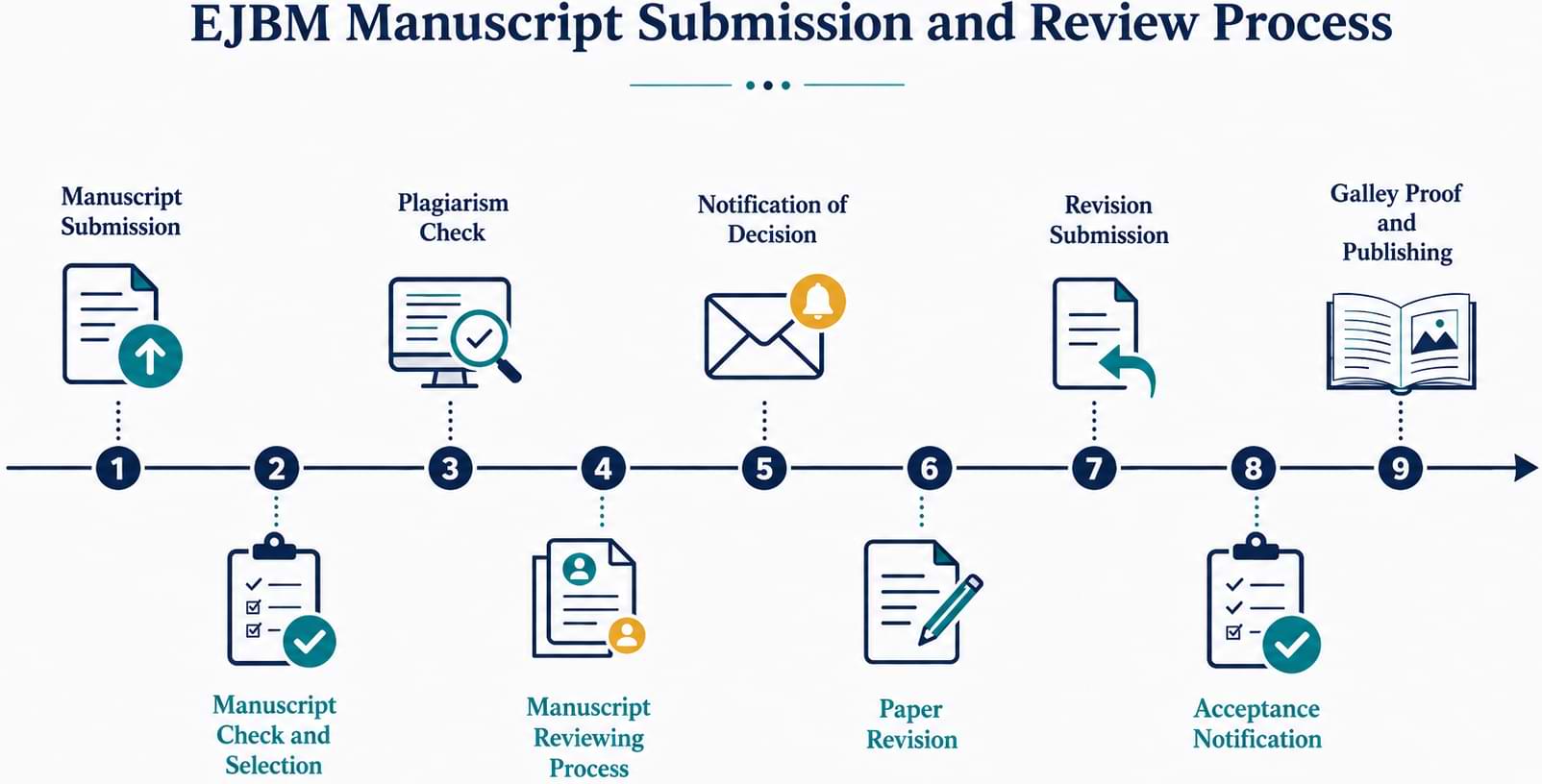
Peer Review Process Flow
Detailed information about the flow from manuscript submission by the author to editorial decision and publication is shown in the following figure.
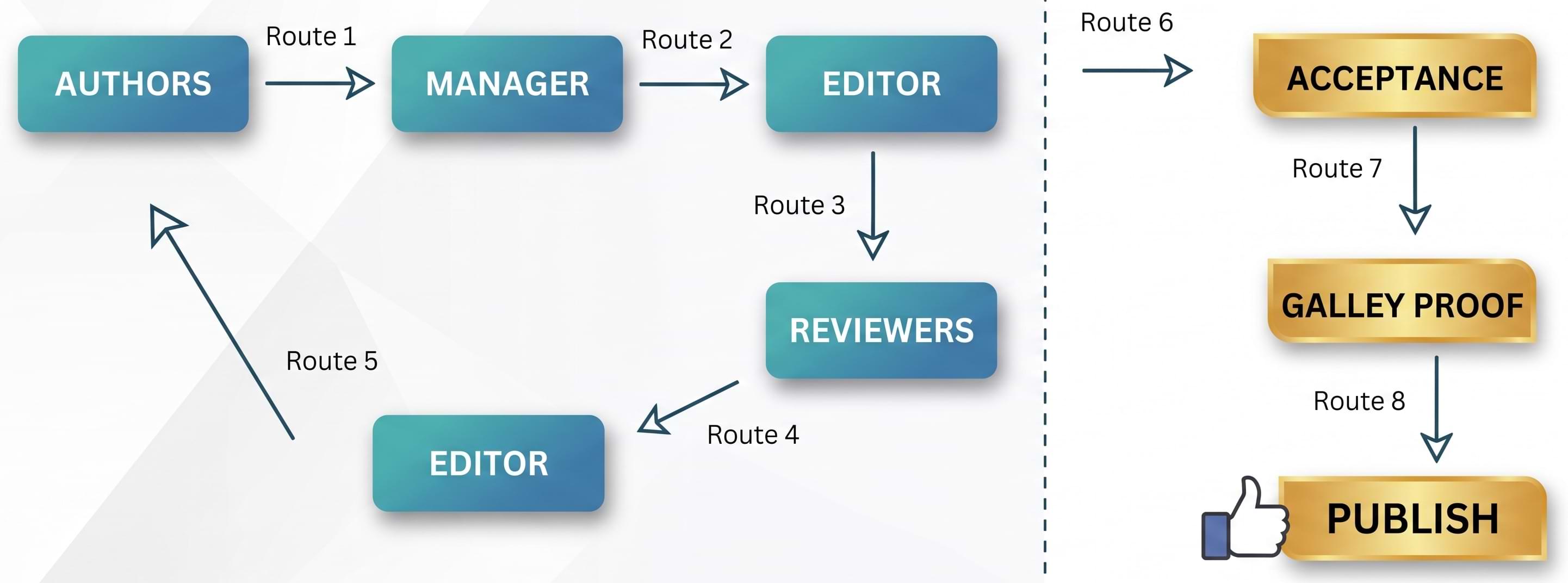
In short, the steps are:
- Manuscript Submission by the author.
- Initial Screening and Selection by the Editor-in-Chief and editorial team, including scope check, author guideline check and plagiarism/similarity screening using tools such as iThenticate.
- Internal Editorial Review by the Section Editor or subject specialist.
- External Double-Blind Peer Review by at least two independent reviewers.
- Notification of Acceptance, Revision or Rejection based on reviewers’ comments and editorial assessment.
- Paper Revision and Response by the author, including a response document explaining how reviewer comments were addressed.
- Revision Verification and Final Decision by the Section Editor, reviewers where required, and Editor-in-Chief.
- Galley Proof and Online Publication after copyediting, proofreading, author proof approval and final production.
The same editorial and peer-review standards apply to regular submissions and special issue submissions. Manuscripts submitted by editors, editorial board members or individuals with potential conflicts of interest are handled by an independent editor who is not involved in the conflict. Reviewers and editors are expected to maintain confidentiality, declare conflicts of interest and follow recognised standards of ethical scholarly publishing.