Effects of Foreign Direct Investment and Institutional Quality on Poverty Reduction in Uganda

Downloads
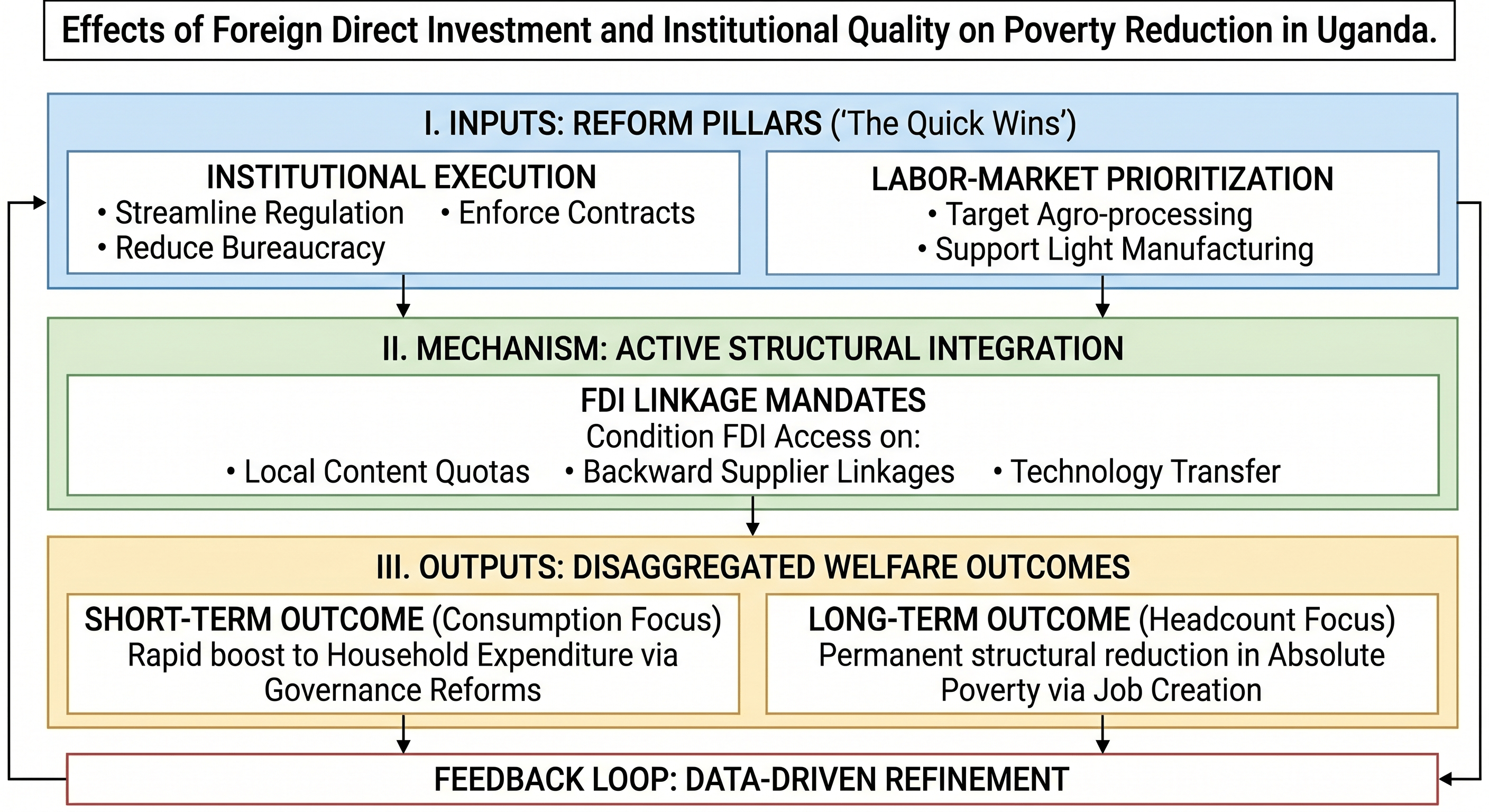
This study examines how foreign direct investment (FDI) and institutional quality shape poverty reduction in Uganda between 1996 and 2024. Based on dependency theory, this paper challenges the prevailing perception that FDI necessarily increases welfare in developing countries. Welfare is determined by two factors: poverty headcount ratio (PHCR) and household consumption expenditure (HCEX). Employment and population are employed as control variables. This research makes use of Autoregressive Distributed Lag (ARDL) approach following the unit root test which suggests that variables have a mixed order of integration. The bounds test establishes long-run cointegration in both poverty models. The results show that employment and population significantly reduce PHCR in the long run, whereas FDI and institutional quality have no significant long-run effect. In the short run, institutional quality improves poverty outcomes by reducing PHCR and increasing HCEX. By contrast, FDI worsens poverty outcomes: it raises PHCR and reduces HCEX, suggesting that foreign capital inflows may operate through enclave structures with weak domestic linkages. The error correction terms indicate rapid adjustment toward equilibrium, with speeds of 0.804 and 0.929 in the PHCR and HCEX models, respectively. The diagnostics reveal the models to be adequate with neither serial correlation nor heteroskedasticity problems, and normally distributed residuals. Labour-intensive industrialization, institutional development, improved targeting of sectors for FDI inflows, and policies to turn the population growth in Uganda into a demographic dividend have been recommended.
Downloads
Copyright (c) 2026 Gideon Mugulusi , Bernard Ojonugwa Anthony, Muhammad Kibuuka

This work is licensed under a Creative Commons Attribution 4.0 International License.